Why Crude Oil Defines All Chemical Pricing
A fundamental principle underpins the global chemical sector and cross-border trade: crude oil is far more than a common fuel. It serves as the core parent raw material for the entire modern chemical industry. The vast majority of chemical raw materials, fine chemical products and industrial auxiliaries are derived from the deep processing of crude oil. The two sectors are deeply intertwined and symbiotic, which explains why every fluctuation in international crude oil prices rapidly ripples through global chemical trade markets. Understanding this inherent correlation allows industry practitioners and buyers to grasp the core logic behind chemical price shifts, cost fluctuations and order delivery arrangements.
Crude oil is universally recognized as the cornerstone of chemical raw material production. While the public primarily associates oil with vehicle fuel, marine shipping and industrial power supply, nearly 30% of global crude oil resources are not burned for energy. Instead, they undergo sophisticated industrial processes including distillation, cracking, catalysis and polymerization to be decomposed and converted into diverse basic chemical intermediates, laying a solid foundation for the entire chemical industrial chain.
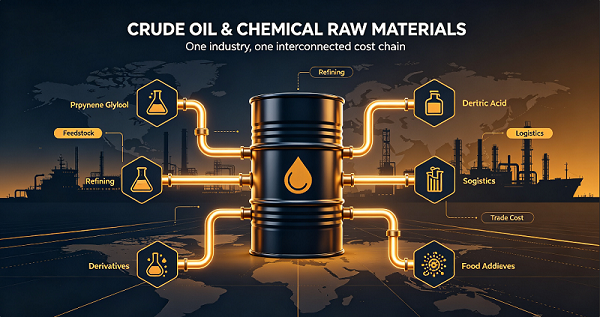
Nearly all mainstream chemical commodities traded internationally stem from crude oil derivative chains. Deep processing of crude oil yields core intermediates such as naphtha, propylene and aromatic hydrocarbons. Through secondary refining and synthesis, these substances are further developed into tens of thousands of chemical products, including propylene glycol, phenol, supporting raw materials for citric acid, various industrial solvents, food additives and rubber and plastic materials. Simply put, bulk chemical products for export are essentially deep-processed derivatives of crude oil. The quality, output and pricing of crude oil directly govern the production costs and market quotations of downstream chemical raw materials.
This tight industrial linkage forms an unyielding transmission mechanism between crude oil trends and chemical market prices. Rising crude oil costs first drive up operational expenses for upstream refineries, triggering synchronous hikes in the prices of basic chemical intermediates. The cost pressure then passes down to midstream and downstream chemical manufacturers, leading to increased expenditure on raw material procurement and product processing. Conversely, falling crude oil prices create room for downstream chemical product price reductions and profit concessions. This is the key reason why mainstream export chemicals represented by propylene glycol face sustained cost pressure and dynamic quotation adjustments amid recent crude oil volatility.
Beyond dominating production-side raw material costs, crude oil also dictates the logistics expenditure of chemical export trade. Ocean shipping remains the primary transportation mode for chemical cargoes, and vessel bunker fuel is entirely refined from petroleum products. Rising crude oil prices directly push up marine fuel surcharges. Coupled with volatile international shipping routes and frequent vessel schedule delays, the overall export costs under CIF terms have increased significantly. The industry is now facing dual operational pressure from surging raw material prices and climbing logistics costs, a prevalent challenge for all chemical export enterprises currently.
Unlike other industrial sectors, the chemical industry has no independent pricing system separate from crude oil. The market trends and supply capacity of both bulk basic chemicals and high-end refined or food-grade chemical products are closely anchored to international crude oil movements. Without the support of crude oil processing and derivation, the entire chemical industrial chain would lose its core raw material foundation, and cross-border chemical trade would lack stable supply benchmarks and standardized pricing mechanisms.
This inherent symbiosis between crude oil and chemical raw materials is an innate industrial attribute of the chemical sector, a market rule that both domestic exporters and overseas clients need to fully recognize. The current cost increases and production schedule adjustments driven by high and volatile oil prices are not arbitrary price hikes by suppliers, but inevitable outcomes of upstream-to-downstream industrial cost transmission. As crude oil prices are expected to remain unstable in the near term, chemical product quotations will continue to fluctuate dynamically. Only through mutual understanding and coordinated cooperation between suppliers and buyers can both sides effectively navigate market cycles, ensure stable fulfillment of cross-border orders and achieve long-term win-win partnership.
Contact: Janet Zhang
whatsapp:
 Janet Zhang
Phone: +86 17700625486
Tel: 86-371-63370468
Email: info@brilliantchemi.com
Add: No.15 Yinping Road,Zhengzhou,China